Venus: What We Hold Dear
Sometimes we take a long time to choose, even when we know perfectly well what we need. Both cups are comfortable to hold. Both armchairs would fit in the room. Either job is within our abilities. We can compare prices, dimensions, working conditions, make a sensible list of advantages. And still, one possibility draws us in while the other leaves us cold.
“I just like this one better,” we say.
Sometimes that means little more than a passing preference. Sometimes it holds an entire vision of life. That armchair makes us want to spend our evenings reading. That table would have room for everyone. That job would finally let us do the work we have wanted to learn for years. Before we can explain our choice in any detail, we already feel it: something here speaks to us.
This is one way into Venus. In astrology, she is associated with love, beauty, pleasure, money, and taste. That familiar list can look like a display of life's appealing things. But Venus becomes especially interesting when we ask what, exactly, a person holds dear in a situation.
One person wants to leave an old recording almost untouched. Another takes delight in a repair that puts precisely the right thing right. A third is willing to give up a good income to keep pursuing work of their own. A fourth enjoys the sense that everything is in proportion and each thing has its place. In every case, life's possibilities cease to be interchangeable. Something calls for us to choose it, sustain it, take care of it.
In the reading offered here, Venus expresses this relationship to what we value. She lets us feel the difference between “that would do, too” and “this is what really matters to me.”
A Star, a Goddess, and the Pleasures of Earth
Venus has held human attention for a very long time. People knew her as the morning and evening star. In Mesopotamia, the planet was associated with Inanna and Ishtar. Even then, her character extended well beyond tenderness and adornment: love lived alongside warfare and power. This ancient goddess knew how to desire, pursue, and demand.
The Greek Aphrodite cannot be reduced to a beautiful supporting role in someone else's adventures either. In the Homeric hymn dedicated to her, her power reaches gods, humans, birds, and beasts. Desire changes the behavior of living creatures, draws them toward one another, disturbs their former peace. Even the goddess herself comes under its spell when she falls in love with the mortal Anchises.
Here, beauty has the power to act on us. The world offers us something, and we can no longer regard everything in quite the same way. One face stands out among many. A familiar place becomes somewhere we long to return. An ordinary day fills with the anticipation of seeing someone.
Roman tradition gives us the familiar name Venus. When the mythological figure enters astrology, another language joins the story: a language of natural qualities and human occupations.
In the second century, Ptolemy described Venus as moderately warm and predominantly moist. In his understanding of nature, these qualities belonged to the discussion of growth and fertility. They helped associate the planet with life given the conditions to flower, soften, and bear fruit. This was the explanatory language of the ancient world, in which a planet's character could be considered alongside the seasons and the changing states of nature.
Some fifteen centuries later, William Lilly painted a thoroughly earthly portrait of Venus. His seventeenth-century astrological account brings together music, fine clothes, bathing, pleasant company, entertainment, and the theater. A favorably placed Venus enjoys peaceful companionship and the pleasures of life together. It is easy to imagine someone who cares about the melody, the clothes, and how the evening went.
For such a person, pleasure takes a particular shape. They notice the feel of a fabric against the hand, a song chosen at just the right moment, a way of speaking. Their presence can make a gathering warmer and more enjoyable. Yet the same attachment to pleasure can turn into idleness, excess, or jealousy. Even the older accounts never made Venus a promise of flawless conduct.
Modern popular guides increasingly express this portrait in the language of preferences. Cafe Astrology, for example, explicitly connects Venus with what we value, our tastes, and our enjoyment of life. Love and money remain important themes, but a broader question emerges behind them: what do we care about?
The morning star thus finds herself among very ordinary decisions. How should we spend a free evening? What kind of work do we want to keep in our lives? How should we treat someone dear to us? What must we preserve when familiar arrangements have to change?
The history of Venus helps us hear more in these questions than a calculation of advantage. There is a longing for a particular kind of life—and an ability to notice when it has become poorer, even if, from the outside, everything still looks fine.
What We Recognize in the Empress
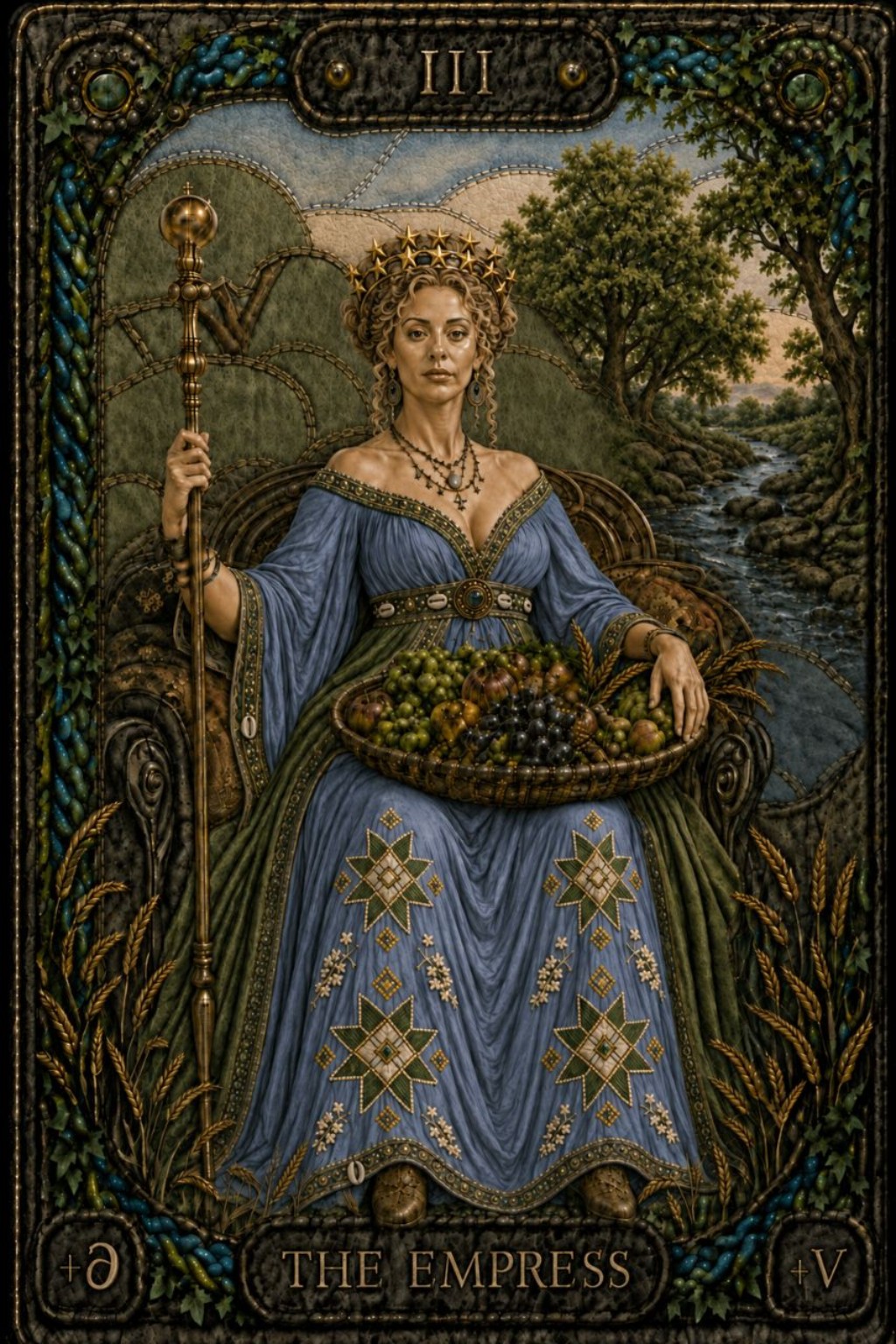
In the Tarot correspondences used here, Venus is represented by the Empress. In the familiar image by A. E. Waite and Pamela Colman Smith, a shield bearing the sign of Venus rests beside her; around her are plants, water, and ripening grain. This is a world with things to grow and eat, to touch and enjoy.
What matters for our story is the sense of earthly fullness in this image. We can examine how an object is made, describe its components, and explain its use. We can also feel its goodness: we want to pick it up, use it, keep it close.
A potter turns a cup in his hands. The wall is a little thicker than he intended. But the rim feels right against the lips, the handle sits comfortably between the fingers, and the glaze catches the light. He will still need to work out what happened in the kiln. For now, though, he can already see something worth keeping in what he has made.
We recognize something similar in relationships. After a conversation, we feel that we have been treated with care. The other person did not rush us, answer for us, or make our disagreement impossible. We may not remember a single especially beautiful phrase, yet still want to see that particular person again.
The Empress helps us hold on to this simple aspect of Venus: life can be good in the living of it. It does not always have to justify itself through some future result. We can love an activity, enjoy a meal, cherish someone's presence.
Alongside “this feels good,” though, a more precise sense gradually emerges: what is it that makes this good for me? Venus then becomes visible in our choices as well. We keep one thing and change another, set aside time for work we love, turn down an attractive offer because it would cost us something that matters.
The capacity for delight sits close to the capacity to say, “This is enough.” And sometimes to a quiet, perfectly definite, “That is something I am not willing to lose.”
From Liking to Valuing
In Astrology 2.0, Pavel Andreev connects Venus with choice, affection, the recognition of value, and a sense of satisfaction. In Bioastrology 2.0, he develops this account through our attitudes toward people, objects, and situations, our tastes, and our capacity for pleasure. His image of Venus as an aesthetic tuning fork is particularly suggestive: something resonates with us; something else fails to strike the right note.
Andreev also distinguishes Venus from the Moon. A feeling directed toward a particular person or object and a changing emotional state belong, in his account, to different astrological functions. The distinction is useful. We can be exhausted by work we love today and still value it. We can be angry with someone close to us and remain keenly aware of what the relationship means to us.
Pleasure, too, deserves a closer look. A person may already have much of what they wanted and enjoy almost none of it. Another may find real satisfaction in a modest life that suits them. Both the ability to choose and the ability to feel the goodness of what is already here matter.
But what have we learned when we say, “This person values family”? One person works to preserve evenings together. Another makes sure everything is ready for tomorrow. A third insists that a child's answer must count. A fourth carefully transfers a family recording to a new medium. The word fits every case, but what matters is organized differently in each.
In What Are Values and How Are They Structured?, I explore twelve distinctions of this kind. They grew out of an analysis of Venus in the twelve signs and were then given definitions in terms of human experience: what we hold dear, how we recognize it in life, which losses we notice, and what we try to sustain.
The stories in that book will therefore guide what follows. The signs offer our starting images; small scenes from life let us see what those images contain. Sometimes a familiar astrological description will become more precise. Sometimes the usual talk of romance, practicality, or independence will open onto something unexpected.
We do not first have to know how to create everything we value. We can appreciate a fine performance without yet being able to play that well. We can recognize the worth of a precise repair without knowing how to handle the tools. Venus expresses our response to what is happening. Making what is needed, understanding it, and passing the skill on are further tasks, involving other planets as well.
Four Pleasures at One Table
Let us return to something utterly familiar: someone enjoying a meal.
One person loves the way the flavors come together. A warm center, a crisp edge, a little acidity, the scent of herbs. Each ingredient is good on its own, but here they have found one another. Add an overpowering spice and you lose the whole that made you want another bite.
Another has come for a familiar loaf of bread. It has just the crust and texture they know. What matters is being able to find that goodness again, made by people they can count on. The pleasure includes that dependability.
A third baked the bread themselves. Several attempts produced heavy dough. Today, they changed one detail and finally got what they were after. The taste is pleasing, but there is another, very particular delight: they found what was wrong, and this was the adjustment that fixed it.
A fourth hardly mentions the recipe. Everyone is home today. Conversation starts of its own accord; someone passes a plate; a favorite piece is saved for the person running late. Serve that same person the same food in an empty room and the taste would remain, but an essential part of the pleasure would disappear.
A single meal can thus bring together a sense of everything fitting, dependability, a precise correction, and an established way of being together. The word “pleasant” alone does not tell us what we have responded to.
Of course, we do not need to go around the table assigning everyone a value. Sometimes a person is simply tasting something and does not yet know what they want to say. A name helps when there is already an experience behind it. Given too soon, it can obscure the person as easily as any ready-made explanation.
Nor does every value demand an expensive sacrifice. A well-spent evening can cost almost nothing. Giving up a convenience shows what a particular choice costs, but the absence of a cost does not make what we cherish any less real. We can preserve something important without necessarily having to pay for it by losing something else.
A choice made under pressure does not always tell us what a person values. Someone may accept a job they dislike because they have a family to support and no other offer. They may give away a beloved possession because there is nowhere to keep it, and go on missing it. A single outward “yes” or “no” cannot settle the question of value. We need to hear what the person would have wanted to keep, what brings them joy, and what loss they still feel when circumstances make them act otherwise.
Pleasure need not turn straight into a decision either. Sometimes we simply listen to music, eat familiar bread, or sit beside someone we love. Being able to feel what is good already belongs to this relationship. Having to choose makes it more visible; it does not bring it into existence for the first time.
Now let us see how these ways of valuing unfold through the twelve signs.
Twelve Ways of Valuing
Venus in Aries
Valuing a beginning. What must be there for us to begin?
Asya and Kirill are planning a writing workshop. Their participants have spent years reading books about literature, watching lectures, and buying notebooks. Almost none have stories of their own yet. Asya wants everyone to write a short scene at the very first meeting.

Kirill suggests easing into it: introductions, some explanation, a few examples. Asya remembers her previous course. Everyone thanked her, but by the final session many still had not brought in a single page. So she keeps twenty minutes of actual writing on the schedule.
She values a particular kind of beginning: a person tries writing for themselves while someone is there to help. She is willing to reduce the assignment to three awkward lines. But if they put off the attempt again, they will have begun a different activity—listening to accounts of how other people write.
In Aries, value gathers around whatever an undertaking needs if it is to be, from the outset, the thing it was meant to be. That might mean making one's own attempt, having an accessible way in, or having the right person present. Venus makes that condition matter to us: we want to make sure it is there now.
The question “What must be there for us to begin?” needs a little care here. Without a key to the room, the meeting may be impossible. Without a period of writing, it can perfectly well take place: people will introduce themselves, listen to Asya, and leave knowing something new. But Asya cares that someone should try writing for themselves at that first meeting. That is why she changes the program. The possibility of holding an evening and the value of a particular kind of beginning meet in the same story, but they answer different questions.
This gives us a fresh way to hear the familiar descriptions of directness and initiative in love. A person may care deeply about a relationship actually beginning: asking someone out, giving a clear answer, no longer keeping another person waiting in an endless “someday.” But speed guarantees nothing. You can arrange a date in a hurry and never begin the conversation you came to have.
The Emperor suggests a beginning that has acquired a definite character of its own. Venus cares that it should begin in that particular way. Sometimes that means asking people already poised to get started to pause for a moment.
Venus in Taurus
Valuing dependable work. What makes a good result possible again?
The lights over the bakery display have long been switched off, but Lida is still weighing flour. Another baker will arrive at five tomorrow morning. He will need clean pans, a clear work surface, and ingredients ready to use. At eight, people will stop in for bread on their way to work.

By any ordinary measure, today was a success: the bread sold, the customers were happy. But Lida knows that today's success will not get tomorrow morning ready. Once, they left everything until later and some of the baking was not done by opening time. A regular customer glanced into the display case and walked away.
She cares that he should find what he came for next time. So the preparation does not feel like meaningless repetition. It keeps something good available for people to count on.
This Venus recognizes the worth of the people, things, and conditions that let what we need return to our lives. A familiar craftsperson does solid work. A friend keeps a promise. A favorite loaf is, once again, just what we hoped for. Dependability can be both known and felt: we can lean on it, reach for a familiar object, go somewhere we will not be let down.
Prepared tins and flour help make tomorrow’s bread possible. Lida can list what the morning’s work requires; someone else can do the same preparation simply because it is their duty. Venus becomes audible in why Lida herself cares how the morning will go for the customers and the next baker. She values people she can count on, and being someone who will not let them down. Dependability here means more than getting the same result at the same time. It includes how these people treat their work and one another.
Tradition associates Taurus with sensuality, quality, and lasting attachment. In our reading, physical pleasure gains another dimension: the good thing is not available by chance. People and their work make it possible, and we want to cherish them.
The Hierophant brings into view a culture of quality that can be passed on. Yet an established routine still needs to be distinguished from something that truly supports us. If the old way is now preventing us from getting what we need, loyalty to habit alone will not save it. We will return to this question in Scorpio.
Venus in Gemini
Valuing the full picture. What can't we leave out?
Polina has been offered a job at a well-known publishing house. She has long dreamed of illustrating children's books and can already picture her own drawings beneath that familiar logo. Her friend Sveta asks an unexpected question: “Will you actually be doing any drawing?”
It turns out that Polina is being asked to oversee other illustrators. There is another offer, too: a small studio, six months on a single book, less money, but she would be doing the illustrations herself. Sveta initially dismissed it as a bit of freelance work. Now she wants to question her own first impression as well.
She cares about seeing the situation from different sides. An appealing name must not obscure the actual responsibilities; a studio's lack of fame must not hide what it could offer. Each possibility begins to reveal its advantages, difficulties, and unknowns.
We can recognize Venus in Gemini in this attitude. The world is interesting in its differences. Another person's perspective can supply something we lacked. A new detail can change a familiar picture, and we care about making room for it even when it complicates a choice we were already drawn to.
This makes sense of the traditional associations with conversation, curiosity, and varied interests. But a wealth of impressions does not in itself make a picture complete. You can know dozens of stories about a publishing house and never ask what you would actually be doing there on a Monday.
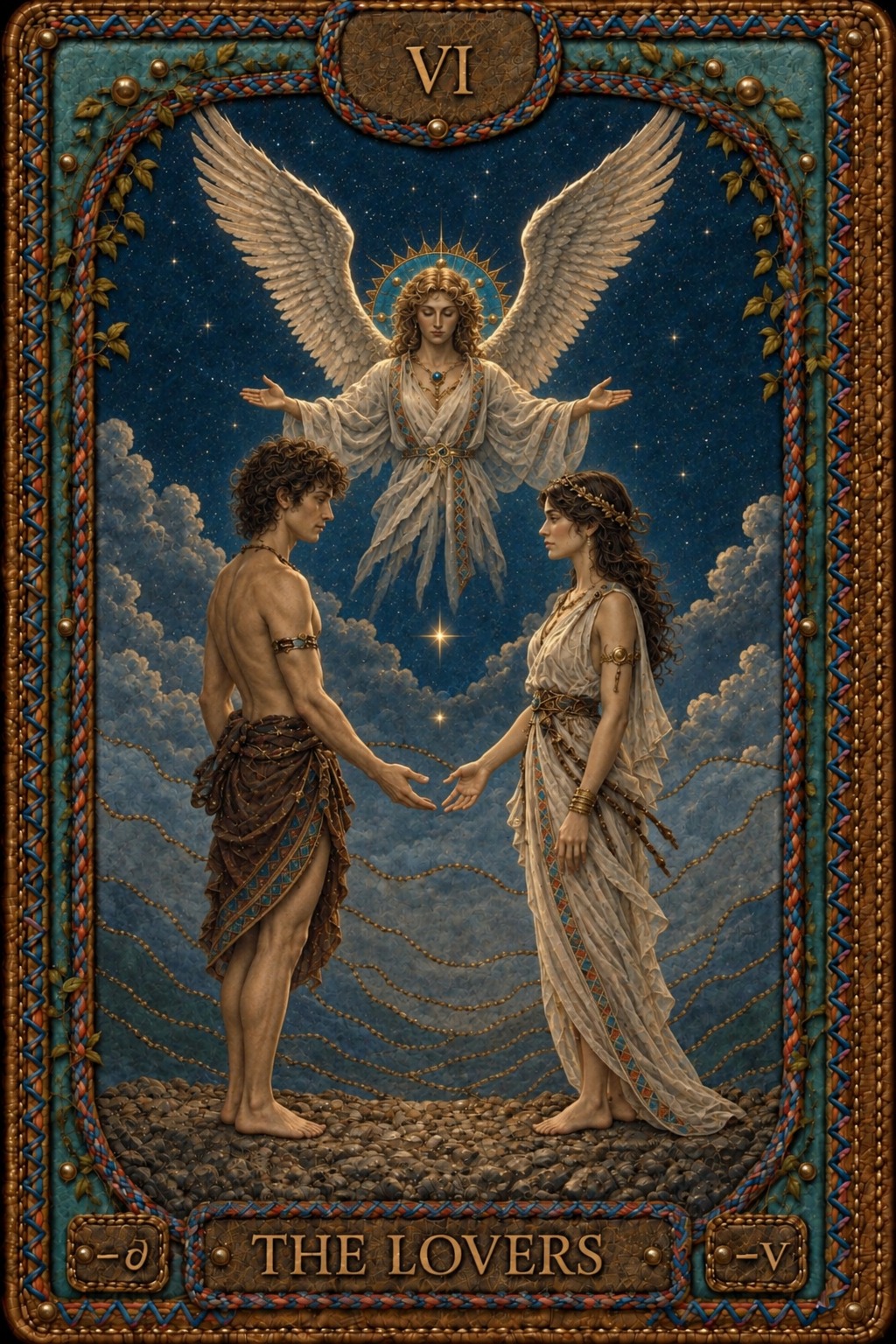
The Lovers let us see distinct perspectives and possibilities side by side. Venus cares that no important voice should vanish from consideration. Mercury will help us communicate and understand what we hear; here, our concern is the willingness to value an encounter with the situation in all its dimensions.
Sveta could understand an inconvenient detail perfectly well and still decide not to return to it: she already likes the offer and would rather not spoil the mood. In our story, she cares that the detail should have its place, even if it makes her reconsider her first liking. Mercury helps her understand what she has heard. Venus is visible in her willingness to value a fuller view when it stops being comfortable. Neither she nor Polina has to collect every fact in existence. What matters is being willing to keep something essential in view, even when it disturbs an already pleasing picture.
Venus in Cancer
Valuing our way of being together. What makes us us?
A family is choosing furniture for the living room. The children are older now, and each has a place to do homework. They could clear the notebooks and building blocks out of the shared room, put a large sofa in front of the television, and finally have a tidy-looking space.

But the mother thinks of their ordinary evenings. Her son is building a toy car. Her daughter is showing everyone photos. Someone is reading; someone else is answering emails. In the middle of it all, a child asks a question they would never have dared put on the agenda of a family meeting. One person sets down their phone; another comes over to help. This is how they have learned to be together.
She wants to keep a place in the room where anyone can bring whatever they are doing. A large table is not essential in itself. What matters more is the familiar possibility of noticing one another, asking for help, joining in. If everyone is left with only a comfortable spot of their own, the family will have lost something.
Venus in Cancer cherishes the shared ways in which a relationship is lived. People come to belong through how they treat one another. A cup is set aside for someone running late. A newcomer is invited to pull up a chair. You can mention a difficulty without first having to earn the right to be heard.
Popular accounts speak of care, home, and attachment to loved ones. That care has a recognizable substance: sustaining the ways of taking part through which a living “we” comes into being.
The Chariot evokes movement in which each person's position is connected to the others. But keeping everyone together at any cost does not necessarily mean caring for the relationship. If people cannot bring their own response, an evening together can easily become an obligation to be performed. Venus values the quality of what happens between people, not merely a room with everyone in it.
Venus in Leo
Valuing work that is our own. What do I need to keep doing to remain myself?
Yegor makes lamps from old equipment. Orders come in steadily; customers like the distinctive look. Then one day he places a light behind a folded sheet of paper and notices how a single crease changes the light on the wall.

A new series begins. One model looks promising in daylight, but in the evening its light disappears into unwanted shadows. Another sheet seems fit only for the trash—until he turns off the overhead light. Experiments accumulate on the table. Yegor cuts back on his usual orders so he can keep going.
What he holds dear is his own work with light. The old casings helped him pursue it for a long time. Now the next possibility has appeared in paper. He can learn from others and use established techniques, but he wants to discover for himself what to do next.
Venus in Leo lets us value this independent thread of work. We can recognize it in a major career or in something almost no one knows about. A person tends a garden, translates stories, coaches a children's team. It matters to them that there should still be an activity they carry forward on their own terms.
Talk of artistry, radiance, and self-expression becomes clearer here. Yet what is truly one's own does not always look impressive. Yegor could go on producing his recognizable lamps for years and one day realize he is merely servicing an old discovery. A new, awkward experiment may mean more to him than a successful repeat.
Strength helps us see the focus involved in sustaining a direction of one's own. Venus expresses its value: we want to protect the time and attention it needs. Recognition can support that work, but it cannot replace the freedom to keep pursuing it ourselves.
Venus in Virgo
Valuing the precise correction. What is needed to put this right?
Natasha asks her brother to prepare an old family video for viewing. It is hard to watch: their father speaks quietly, while their mother, close to the microphone, replies far too loudly. The volume needs adjusting all the time.

Mitya is used to editing short clips, so at first he does what he knows: he removes pauses and repetitions. The video becomes livelier, but Natasha is unhappy. Their father never spoke in such a hurry. And the main difficulty is still there.
They listen to a short passage together. Mitya evens out the volume of the voices, leaving the original pace intact. Natasha plays it on her phone and, for the first time, does not reach for the buttons. Now she can hear.
He is delighted by the precision of the adjustment. He changed what was getting in the way and can hear exactly how the result has improved. Venus in Virgo is recognizable in this response: a person values a correction that addresses the actual fault.
The traditional attention to detail now has something definite to attend to. What is needed is a meaningful distinction, rather than the longest possible list of flaws. The pause was part of the conversation. The jump in volume made the conversation hard to hear. Good work begins when we stop trying to fix one in place of the other.
The Hermit lights a small area in which much becomes clearer. This Venus can express care very quietly: repairing an awkward clasp, spotting an error in a route, making an old letter legible again. It is especially important to be willing to notice that something unfamiliar is not necessarily broken. Otherwise, diligent improvement may destroy the very thing that made it good.
Natasha can appreciate the value of an exact correction without knowing how to level the sound herself. Mitya can make it competently without feeling the delight it brings him in our story. The ability to fix something and the pleasure of seeing exactly the right adjustment work do not always belong to the same person. So the question “What does it take to put this right?” also asks something about our attitude: do we notice the difference between help that is needed and a determined effort to change something that was already good?
Venus in Libra
Valuing the other person's answer. Whose voice must be part of the decision?
Let us return to the writing workshop. Asya has told the participants that everyone will read their scene aloud to the group. Nina replies that she wants to write and would like feedback from the teacher, but she is not ready to share her work with everyone yet.

This was exactly why Kirill proposed a first session without any writing. Now he makes his concern more precise: he and Asya agreed between themselves, but Nina is the one who would have to read. Their certainty that the exercise would be good for her cannot stand in for her own answer.
Here, Venus values the other person's place in the decision. You can ask them and hear an answer that will genuinely change something. If the predetermined plan goes ahead whatever they say, outward politeness will not create the relationship Kirill is seeking.
In the end, the writing stays on the schedule. Each participant chooses whether to read their scene to the group or show it only to Asya. The value of a real beginning has been preserved, and Nina's answer has been given room to matter.
Popular descriptions associate Venus in Libra with tact, fairness, and partnership. Their living substance becomes especially clear when someone refuses to agree on another person's behalf. That can require a fairly firm conversation. A calm tone helps us hear one another, but sometimes the relationship has to be defended against pressure delivered in the nicest possible way.
Justice keeps the distinctness of the parties before us. We may want the same undertaking and respond differently to an invitation to take part. Venus lets us cherish a relationship in which each person's answer remains their own.
Venus in Scorpio
Valuing release. What do we have to let go of?
While Lida gets the bakery ready for tomorrow morning, Roman is finishing a custom cake. Cakes like these helped them survive their first year. They look beautiful, customers are happy, and new requests are hard to turn down. But they are also the reason the evening's preparation keeps starting late at night.

Lida suggests hiring another baker. Roman points out that the new person would be using the same oven and the same two worktables. If they keep accepting everything that comes their way, the excess workload will simply acquire another pair of hands.
He cares about freeing their main work from what is making it hard to continue. So he proposes finishing the cakes they have already promised and taking no new orders for them. Time opens up in the schedule for preparation, no longer available to be sacrificed for one more exception.
Venus in Scorpio lets us feel the value of this kind of release. A service, obligation, or relationship may once have been good and given us a great deal. But now we have to keep sustaining it at the expense of something we want to keep alive.
This lends a different meaning to the familiar language of intensity and difficult change. A fairly decisive “no more” may be needed here. Yet the value does not lie in destroying as much as possible. Letting go needs to make room for something to continue. Roman wants the bakery to be able to bake its bread properly, and he wants Lida and himself to be able to go home.
Death makes the ending visible. Gratitude for what once helped us does not oblige us to preserve its old form forever. Taurus asked what would support tomorrow morning. Scorpio notices what it is time to part with for that morning's sake.
Venus in Sagittarius
Valuing direction. What keeps us from ending up somewhere we never meant to go?
Polina has now established how the two job offers differ. It is time to choose. The large publishing house offers a secure position and a high salary. At the small studio, she would spend six months illustrating one book; there is no promise of another project after that.
She tries to picture an ordinary week in each place. At the publisher: choosing illustrators, discussing sketches, managing deadlines, leading a team. At the studio: her own drawings, the editor's comments, revisions. Gradually, she begins to see what a year of weeks like these would teach her.
Polina values movement toward a particular kind of work: learning to tell a story through pictures, making a whole book. Managing illustrators could also become an interesting life. But then she would still have to draw her own first book in the evenings, just as she does now.
Venus in Sagittarius lets us value a direction sustained through actual steps. Improvements can be real and still lead different ways. We care about relating the opportunity before us to the life we wanted to move toward.
This helps us understand the traditional interest in growth, travel, and broad horizons. But movement alone does not tell us whether we are on our way. You can visit dozens of countries and keep postponing the thing you originally wanted more freedom to do.
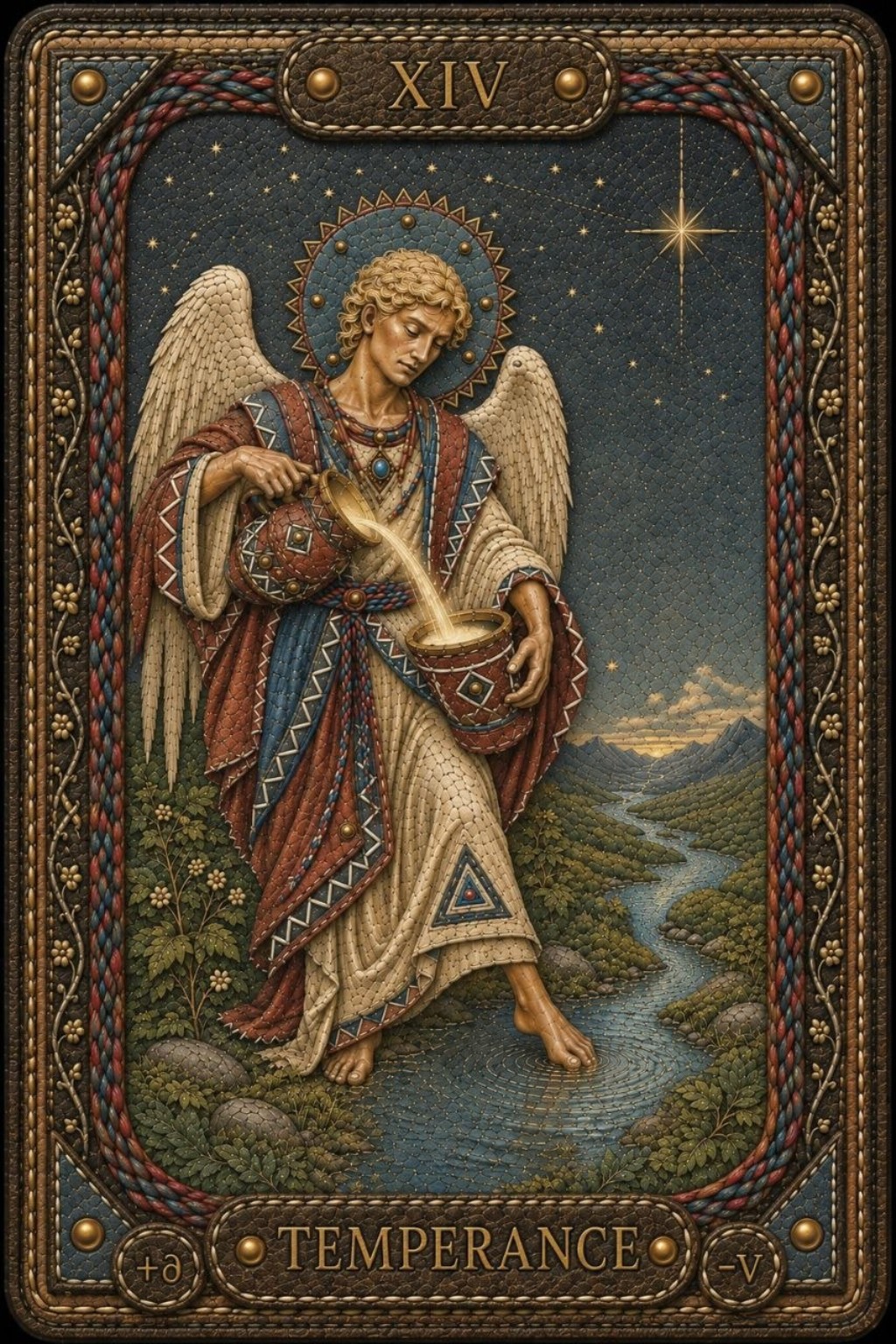
Temperance evokes a transition in which the next move must be in keeping with the course already being pursued. Polina chooses the studio, knowing both the advantages and the cost of her decision. Venus appears in the fact that, for her, the chance to do her own drawing now matters more than a more impressive job title.
Venus in Capricorn
Valuing how things fit together. What lets each part belong?
At the furniture store, the family has found a large sofa and a large table. Each is good on its own. On the floor plan, though, it becomes clear that anyone sitting down would have to get up every time someone else wanted to reach the window.

The father, who initially suggested clearing the children's activities out of the living room, is reconsidering his arrangement too. It looked tidy, but the little table in front of the television would not serve the evening the family wants to preserve. Now they choose furniture with people's movements in mind: where each person will sit, what they will put beside them, how someone else can come over.
They settle on a smaller sofa, an extendable table, and a shelf for unfinished work. The objects make room for one another, and a whole emerges that is a pleasure to use.
Here, Venus values the way the parts work together. This might concern the layout of a room, the flavor of a dish, a quartet's performance, or the order of a work meeting. What matters is how one thing relates to another and what they become together. Even a beautiful object can be one thing too many in this particular setting.
The practicality of popular Capricorn descriptions gains an aesthetic depth in this reading. Something well composed can be beautiful before we call it useful. A fitting proportion leaves room to breathe; a pause lets us hear a phrase; a short presentation prepares the conversation that follows.
In this sequence of images, the Devil draws attention to interconnectedness: the parts set conditions for one another. Venus cares that the relationship between them should fit. Cancer noticed how the family lives together. Capricorn helps us value an arrangement that gives that life a place.
Venus in Aquarius
Valuing a shared principle. What gives us common ground?
Yegor's lamps are listed in a catalog called Second Life. Alongside them are restored bicycles, altered coats, and repaired armchairs. The workshops are independent, and their work varies widely. Lada, who runs the catalog, selects it on a shared principle: an object can be used again; its life has been extended.
She likes Yegor's new paper lamps. But she will not include them here: they are made from new materials. Old maps would preserve the principle. Yegor, however, needs a different paper, or he will not get the light he has discovered.
Lada values the shared idea that lets very different pieces of work make sense alongside one another. Knowing the maker cannot take that idea's place. She is willing to include a bookbinder she has never met who restores old books, and to turn down a new series by a longstanding contributor.
Venus in Aquarius appears in our relationship to something shared that does not require sameness. Teachers of different subjects, for instance, may all value a student's independent reasoning. One explores a poem; another sets up an experiment. The forms differ, but the principle remains recognizable.
Tradition speaks here of independence, friendship, and the unusual. But being unusual does not, by itself, bring anyone together. What matters is the basis for recognizing something common beneath the differences and applying it to a case we have never encountered before.
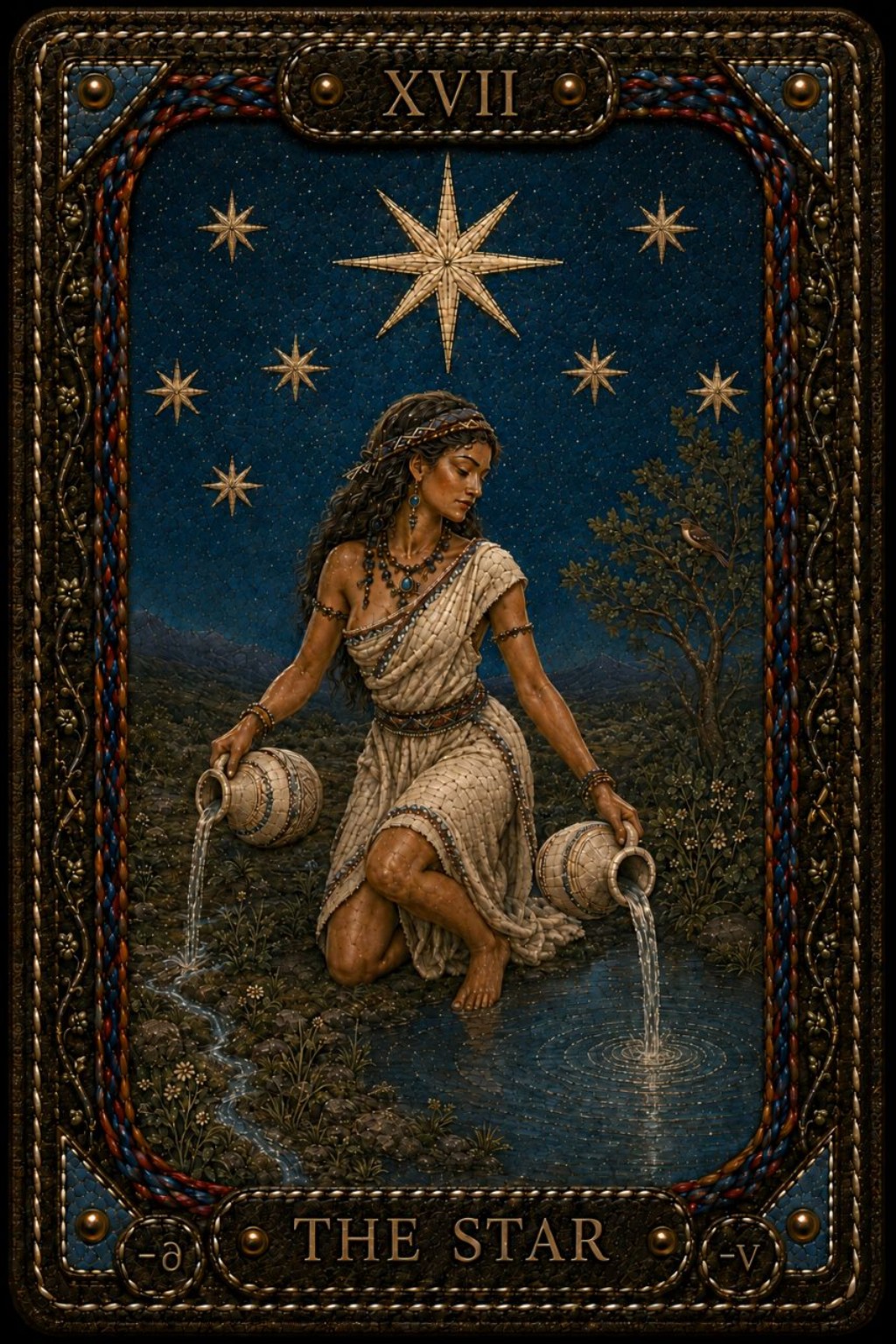
The Star sustains the image of a point of reference visible from different places. Yegor does not have to abandon the paper lamps: he presents the new series separately. His own work continues, and the catalog keeps its meaning. Venus can value both relationships, even when they cannot fit on the same page.
Venus in Pisces
Valuing continuity. What must we carry forward?
In the family video, their father is telling the story of how he once happened to find himself near their mother's house. Then he falls silent, smiles a little, and looks toward someone behind the camera. Their mother replies, “And then you kept happening to find yourself there for another month.”
Mitya's short edit kept both remarks. What disappeared was the eight seconds between them. The information survived, but Natasha hears the loss: this is how their father always told a story. He left room for an answer, and their mother already knew where he was going.
Natasha cares about carrying that living manner into the new recording. She wants the children to meet the people telling the story, hear their pace, wait for the smile. So she asks him to restore the pause. She is perfectly happy for him to even out the volume: that change helps preserve the conversation.
Venus in Pisces is recognizable in the value placed on continuity. The medium, the place, the people involved, the ways of working may all change. What matters is carrying something through that change without which the new would no longer continue the old.
The familiar romanticism and sensitivity to subtle things acquire a definite object here. A small pause may convey no new fact and still hold what we cherish. Sometimes preserving it requires a bold change of outward form: teaching a song differently, arranging a gathering in a new way, finding another setting for a familiar activity.
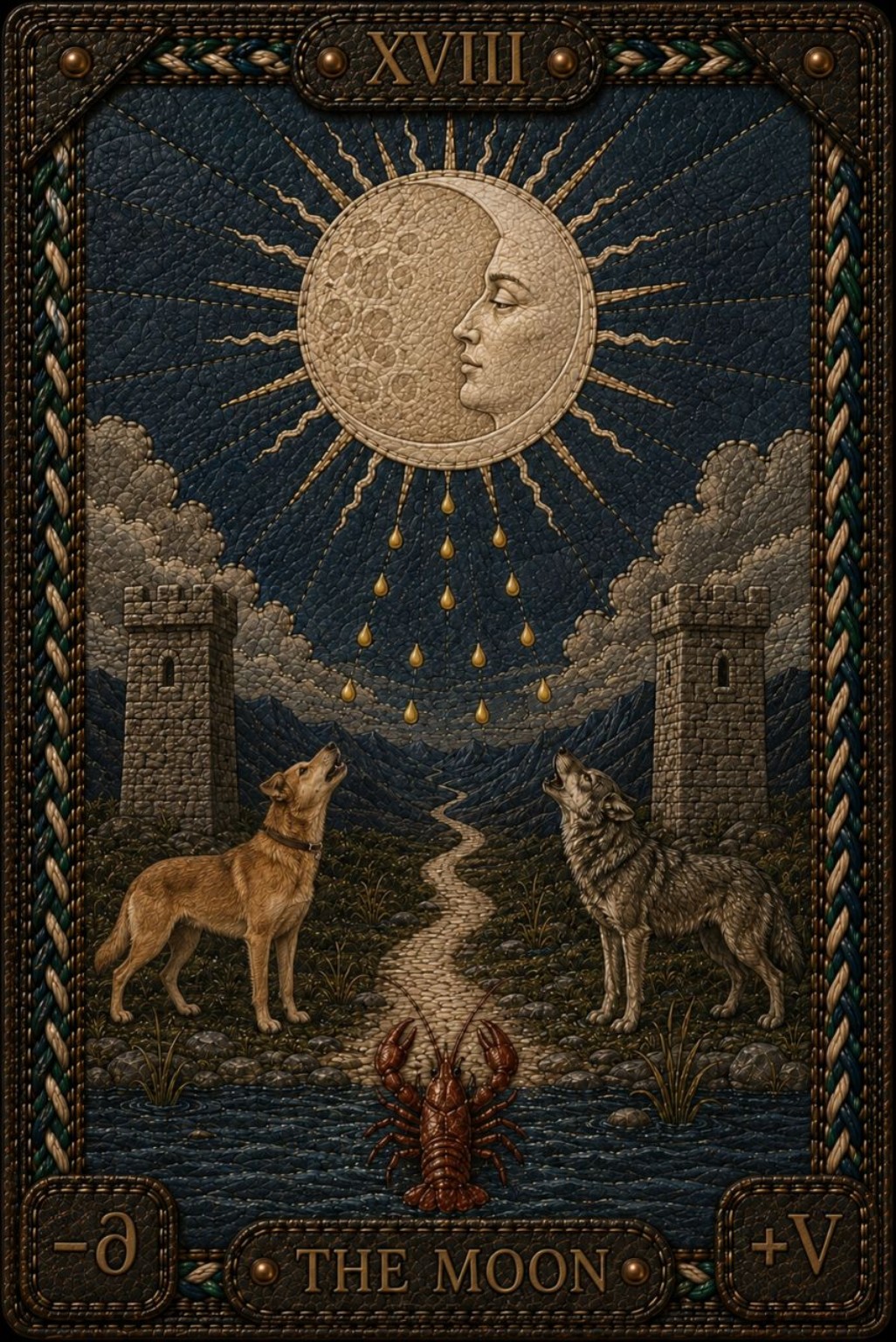
The Moon evokes a whole that is not always fully or directly expressed. Venus feels the value of its continuation. She lets us say: we can fix the sound, remove the music, replace the medium—but this look and this moment of waiting must stay.
Natasha may care deeply about her father’s way of telling a story and still fail to preserve it when the recording is transferred. Someone else may prepare the video with great care, even though it carries no family memories for them. Venus and Neptune come particularly close here. One helps us see why we want to keep the pause; the other question is whether the living connection between the father’s story and the mother’s reply remains in the new recording. Deep attachment does not guarantee that something will be preserved successfully. Nor does successful preservation require everyone working on it to share the same attachment.
That evening, Natasha watches the video with her son. He is already reaching to skip the silence when he notices the smile. “He was going there on purpose, wasn't he?” His grandmother answers from behind the camera. They laugh along with her.
When What Matters to One Meets What Matters to Another
In all these stories, people resisted something. Asya did not want to postpone the participants' own attempt at writing. Kirill did not want to decide for Nina. Lida protected the preparation time. Roman wanted to remove the excess workload. Yegor pursued his own work; Lada preserved the common principle. From the outside, any one of them could have been called stubborn.
But behind the resistance was a value the person had already learned to recognize. They could see what would disappear if they accepted the outwardly convenient solution.
The six axes help us see twelve ways of valuing side by side. Beginning something real and leaving the other person free to answer for themselves. Making it possible for a good result to recur and freeing its continuation from what gets in the way. Seeing the situation fully and keeping a sense of direction. Caring for a shared “we” and bringing the parts of a whole into a fitting relationship. Pursuing work of one's own and recognizing a common principle. Correcting precisely and carrying through change what we want to preserve.
In life, any of these can come into conflict. Evenings together take time needed for one's own work. A useful change disrupts familiar ways of living. A dependable income leads away from the activity we wanted to pursue. Venus does not spare us these decisions. She helps us feel more clearly what is at stake in them.
And a person can learn to recognize both sides. Asya learns to ask about participation; Kirill learns not to remove the possibility of writing along with the pressure to do it. Mitya begins to hear what needs correcting and what makes the recording alive. Natasha notices that the right adjustment helps preserve what is dear to her.
Sometimes this leads to a happy combination. Sometimes it leads to an honest separation: one series of lamps will remain in the shared catalog, while another continues on its own. There can also be a loss that no good conversation can undo. Understanding the value then helps us at least avoid declaring worthless what we had to give up.
Enough to Enjoy
We began with a cup, an armchair, and a job that proved hard to choose from a list of advantages. Now we can hear more behind the simple words “I like it.” I care that I can count on this. That my answer matters here. That I can keep doing my own work. That we remain close. That even after the changes, this particular person can still be heard in the new recording.
Mercury helped us put what we understood into our own words. Venus lets us feel why we want to speak about it at all, return to it, and find a place for it in our lives.
Sometimes that response shows itself in a major decision. Sometimes it is there in the way someone clears the unnecessary things from the table, leaves a single lamp on, and sits down beside us. Everything that matters is already here. There is nothing we want to add.
The Empress brings us back to this possibility: a life we can love, not just keep in order.